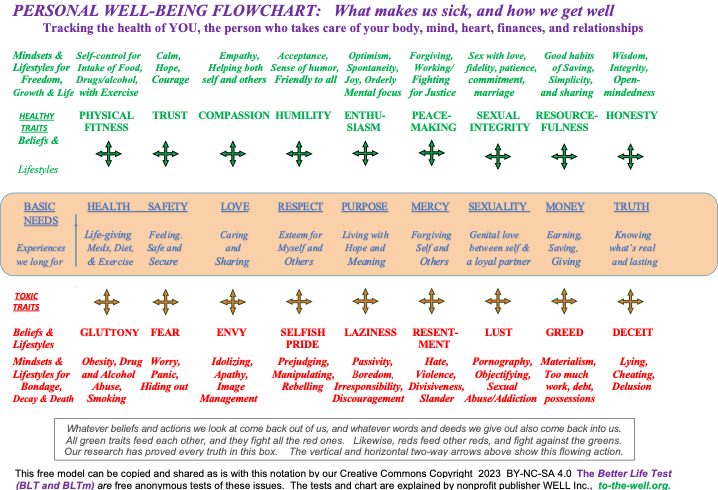
The middle flesh-colored row is our universal human experience – we are all made to long for these experiences, and others long to receive them from us. Each of these nine core issues can be expressed in either healthy or unhealthy ways. The healthy ones are shown at the top in green, and the unhealthy ones are portrayed below in red. The arrows show the flow: growing any of the green items tends to grow the others, by making us want to grow up and experience other fulfilling realities, responsibilities, and relationships. Likewise, all of the red traits stimulate the growth of other red beliefs and habits.
KEY CONCEPTS FOR A BETTER LIFE
DEFINING HEALTHY Our modern concept of quick symptom relief doesn’t get to the root of sickness. Instead, our free, anonymous online test (the Better Life Test - mini, the BLTm) defines what’s healthy as whatever does the most good and the least harm for the most people in the long run. Seeing healthy this way is practical, reminding us that health and sickness are both contagious, as we take in what we put out, and vice-versa.
HALLMARKS FOR HEALTH We look for six main signs of health: cooperation, strength, growth, caring, freedom, and gratitude. Sickness brings just the opposite: division, weakness, decay, apathy, bondage, and complaint. These hallmarks of life and death are important but invisible: they can only be seen by the eyes of a trained heart and mind. WELL gives you that training.
NINE BASIC ISSUES For3000 years, health experts have taught we need to take in nine experiences(and give out nine expressions) of life for thriving, flourishing, self-confidence, and self-esteem: · HEALTH (… to exercise, diet, and medicate) · SAFETY (… to feel safe and secure) · LOVE (… to care and share) · RESPECT (… to feel self-worth) · PURPOSE (… to find meaning, hope) · MERCY (… to forgive) · SEXUALITY (… to save/use genital contact for healthy, loyal pair bonding) · MONEY (… to earn, save, give) and · TRUTH (learning how … to know what’s real).
PADs Life comes into and out of us as we connect with People, Associations, andDreams (PADs). We can think of them as sources of life, but better to see them as resources, channels and carriers of life. WELL shows you to discern how healthy your PADs are for you, before you take or give too much with them.
WELLSPRINGS & WHIRLPOOLS PADs showing the hallmarks for health often cooperate to create intangible attitudes of overflowing fullnessin people. Such PADs are for us external WELLSPRINGS, and as we pay attention to them, they gradually become internalized, into healthy mindsets and lifestyles for us. Give from these internal wellsprings and you find the more you give of yourself, the more you are able to give.
By contrast unhealthy PADs often compete to consume finite, tangible resources, at the expense of others who end up with less. Mindsets and lifestyles of draining emptiness work like WHIRLPOOLS to exhaust inner strength from you and others. To disengage from whirlpools, pull back the attention you pay them.
PAYING ATTENTION Whatever you pay attention to will grow, both inside you and out. So will whatever we call others’ attention to. To disconnect from a toxic PAD, take back the attention you give it, and give your attentions elsewhere, to healthier PADs. We can give five levels of attention to our PADs:
Level 1 = Attention ~ deliberately focusing ourselves to notice a PAD
Level 2 = Acceptance ~ deciding it’s relatively harmless, and worth exploring further
Level 3 = Affection ~ becoming charmed by paying attention mostly to the positive
Level 4 = Allegiance ~ joining, subscribing, committing to be together regularly
Level 5 = Adoration ~ idolizing a PAD, and believing that it is virtually always healthy.
You absorb unhealthy traits when you give them positive attention, or when you give negative attention to healthy attitudes. You can give negative attention also in five levels: Disregarding, Disliking, Disapproving, Disengaging, and Demonizing. Finally, don’t think you can just change your patterns of paying attention by willpower alone. You’ll need to tell others what you’re doing, tell them why, and ask for their help reframing these mindsets.